Is Your Date Night Boring — or Are You?
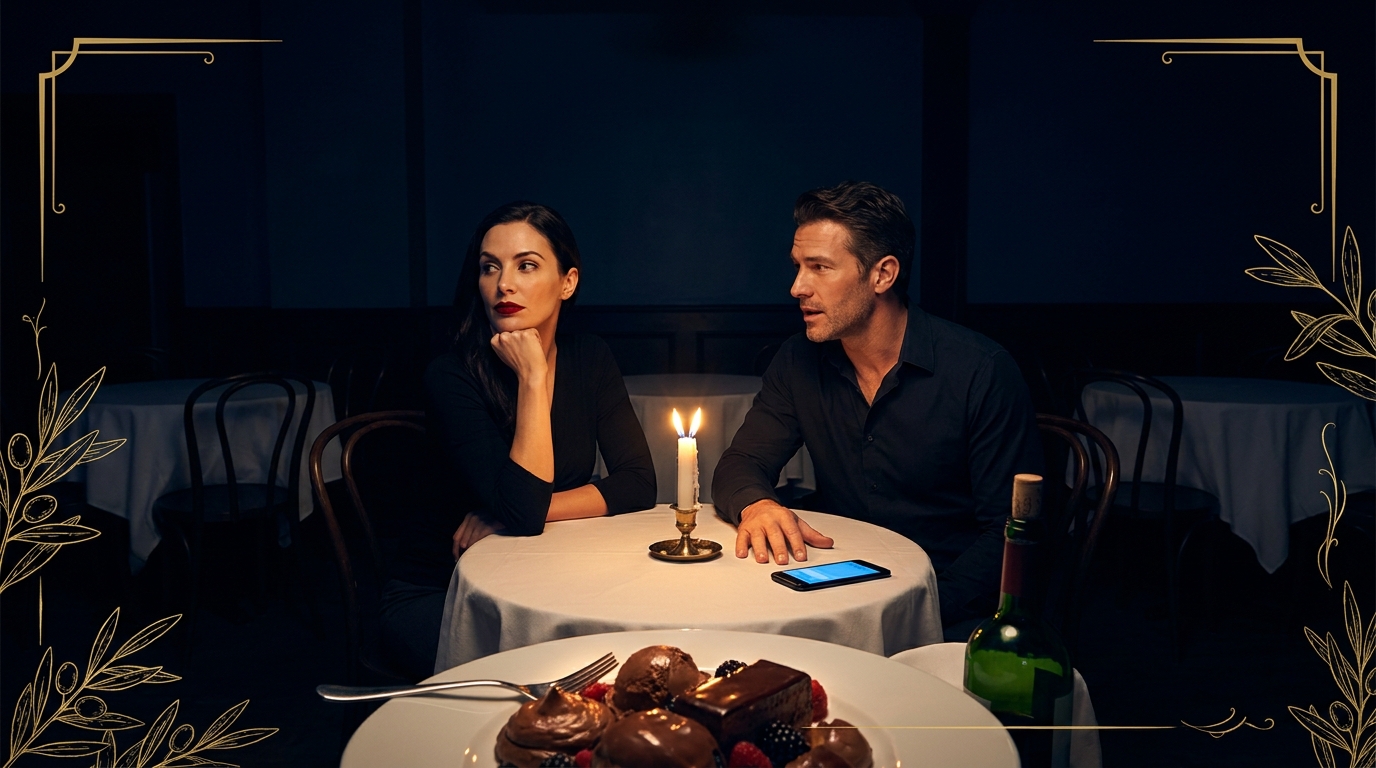
Your date night isn't boring — you're bringing autopilot to a nicer table. Date nights fail because couples change the location but not the dynamic. The missing ingredient isn't a better restaurant. It's intention: one element planned on purpose. Change that, and the same night wakes up.
TL;DR
- Date night stopped working the day it became a location change instead of a dynamic change — same conversation, nicer table, bigger bill.
- The autopilot rides along. You can't out-restaurant a habit of not really looking at each other.
- What makes a night actually feel different: novelty, a role you don't usually play, and a little not-knowing.
- The fix is intention, not activity. One element planned on purpose changes the whole evening — no reservation required.
- If you'd rather have the entire evening designed instead of improvised, Appetite for Seduction's Zodiac Date Night Guides build the menu, pacing, and mood around how your partner is actually wired.
Why Date Night Stopped Working: Same Conversation, Nicer Table
Picture the last one. You booked the sitter three weeks out. You put on the good outfit, drove twenty minutes, sat down at a table with actual candles — and spent ninety minutes on the kids' schedules, the gutter situation, and whether your coworker is quitting. Then you split a dessert, drove home, and went to bed a little deflated, wondering why the magic restaurant didn't produce magic.
Because restaurants don't produce magic. They produce dinner. You upgraded the location and brought the exact same dynamic — the shorthand, the logistics, the comfortable half-attention you run at home. Same conversation, nicer table.
Esther Perel — the Belgian psychotherapist who rewired how the world talks about long-term love — has been saying a version of this for years: her work on why desire fades in long-term relationships keeps landing on the same point, that desire runs on mystery, distance, and seeing your partner as someone still slightly unknown. A standing reservation at the usual spot offers exactly none of that. It offers a booth.
Don't get me wrong — I will never argue against a beautiful meal someone else cooks. But if the night keeps falling flat, the venue was never the variable. The choreography was.
The Mirror Moment: You Bring the Autopilot With You
All right, this is the part where I love you enough to tease you a little. You say date night is boring. Chérie — what did you bring to it? You arrived with your phone face-up, your default seat, your default order, and the same three questions you've asked since 2019. The evening didn't stand a chance, FR.
This isn't scolding — it's the happiest news in this whole article. If the problem were the restaurant, you'd need a better city. If the problem is autopilot, you need about ten minutes of thinking differently, and you already own everything required. Autopilot is what turned you into extremely competent roommates in the first place; date night just puts it under better lighting.
After eight years of teaching couples, I can tell you the pattern by heart: nobody's bored with their partner. They're bored with the script they keep running at their partner. There's a whole interesting person sitting across from you — you've just stopped auditioning for them, and they've stopped auditioning for you. That's fixable. That's the most fixable thing in the world.
What Actually Makes a Night Feel Different
Three ingredients, and none of them is a tasting menu: novelty, roles, and a little not-knowing.
Novelty first. Psychologist Arthur Aron — the researcher behind the famous “36 questions that lead to love” study — built a body of work on self-expansion showing that couples who do new, slightly challenging things together report more attraction than couples who do pleasant, familiar things. Your favorite restaurant is pleasant and familiar. That's exactly the problem with it.
Roles second. In a long relationship you each calcify into a part — the planner and the passenger, the talker and the nodder. Swap one role for one evening and watch what happens to the temperature. It's the same reason cooking together works when it's collaborative: the moment you're doing something unscripted with your hands, the script loses its grip. The Craft NightBachelorette Parties experience I’m building is built on exactly this — small, structured role play with food, where somebody leads who doesn't usually lead.
And the not-knowing. Research in the Journal of Social and Personal Relationships — the academic journal where much of the field's work on long-term desire lands — keeps connecting sustained desire to uncertainty in small, safe doses: a plan your partner hasn't been briefed on, a question they didn't see coming. The candlelit build-up, the unfamiliar menu, the sentence that starts “I've never asked you this” — and then the pause. That pause is the whole product. Restaurants can't sell it. Only you can make it.
The Intention Shift: Plan the Dynamic, Not the Venue
Here's the thing — and it's the reframe this entire brand is built on: a date night isn't an outing. It's a designed hour. The couples who keep desire alive aren't the ones with the best reservations; they're the ones where somebody, on purpose, decided what the evening was for.
John and Julie Gottman — the married research team with four decades of data on what keeps couples together — call these deliberate, repeated practices rituals of connection, and their research is blunt about it: connection comes from intentional structure, not from proximity. Sitting near each other at a nice place is proximity. Deciding in advance who's leading, what gets asked, and how the night should feel — that's structure.
Intention sounds unsexy, I know. It sounds like a spreadsheet. But think about the best date you ever had — early on, when everything was electric. Somebody planned that. Somebody picked the place, rehearsed a line in the mirror, thought about what you'd love. You weren't feeling spontaneity. You were feeling intention, wearing perfume. That's the entire premise behind the Zodiac Seduction Guide collection — every evening in it is designed on purpose, down to who does what and when, because “on purpose” is the actual aphrodisiac.
What to Try Tonight
One reframe, one assignment: plan a single element of tonight on purpose. Not the whole evening — one element. Decide who does what, deliberately: one of you runs the night start to finish, and the other's only job is to be a guest — no helping, no managing, no “are you sure about the music.” Then, at the table, ask one question you have genuinely never asked this person. Not “how was your day.” Something you actually don't know the answer to.
That's it. Same house, same budget, same Tuesday — one planned element, one unasked question, and suddenly there's a little not-knowing in the room again. Try it. It just might lead to something...
That's the free version, and it works. The full version — the whole evening designed as an arc, the menu matched to your partner, the pacing decided so nobody has to improvise the mood — that stays in the guides, because that's the craft. Start with the Food Fantasy Quiz if you don't know which evening your person needs; it takes three minutes and it's more honest than they'll be.
An entire evening built around how your partner actually experiences desire.
Frequently Asked Questions
Why does date night feel boring?
Because you changed the location, not the dynamic. Couples upgrade the restaurant and bring the same conversation, the same roles, and the same half-attention they run at home — so the night feels like an expensive rerun. The missing ingredient is intention, not a better venue.
How do I make date night interesting again?
Add one deliberate element: a role swap, a plan one partner isn't briefed on, or a question you've never asked. Interest comes from novelty and a little not-knowing — both of which are free — not from a bigger budget or a farther drive.
What should couples do instead of dinner and a movie?
Anything that makes you collaborators instead of spectators — cook a dish neither of you has made, let one partner design the whole evening as a surprise, or build the night around questions instead of a screen. Appetite for Seduction's Zodiac Date Night Guides turn that idea into a fully designed at-home evening, matched to your partner's sign.
How often should couples have date night?
Put one on the calendar weekly if you can — but frequency is the wrong scoreboard. One intentional night a month beats four autopilot dinners, because connection tracks with how deliberately the time is designed, not how often you go out.
Are at-home date nights better?
For most long-term couples, yes — home gives you collaboration, privacy, and zero performance pressure, which no restaurant can offer. The catch: home only works when something is planned on purpose. An unplanned night in isn't a date; it's a Tuesday.
What is an intentional date night?
AFS founder Shani Delamor defines it as an evening where at least one element is designed on purpose — who leads, what happens when, and one moment your partner doesn't see coming. After eight years of teaching couples, her shorthand is simple: change the dynamic, not the location, and the same night becomes a different night.
Sources
- Esther Perel — “Desire in Long-Term Relationships.” estherperel.com
- Psychology Today — Self-Expansion Theory (Arthur Aron). psychologytoday.com
- The Gottman Institute — “Rituals of Connection.” gottman.com
- Journal of Social and Personal Relationships — novelty, uncertainty, and long-term desire. journals.sagepub.com