Your Kitchen Is Either Foreplay or Chores. Which One Are You Running?
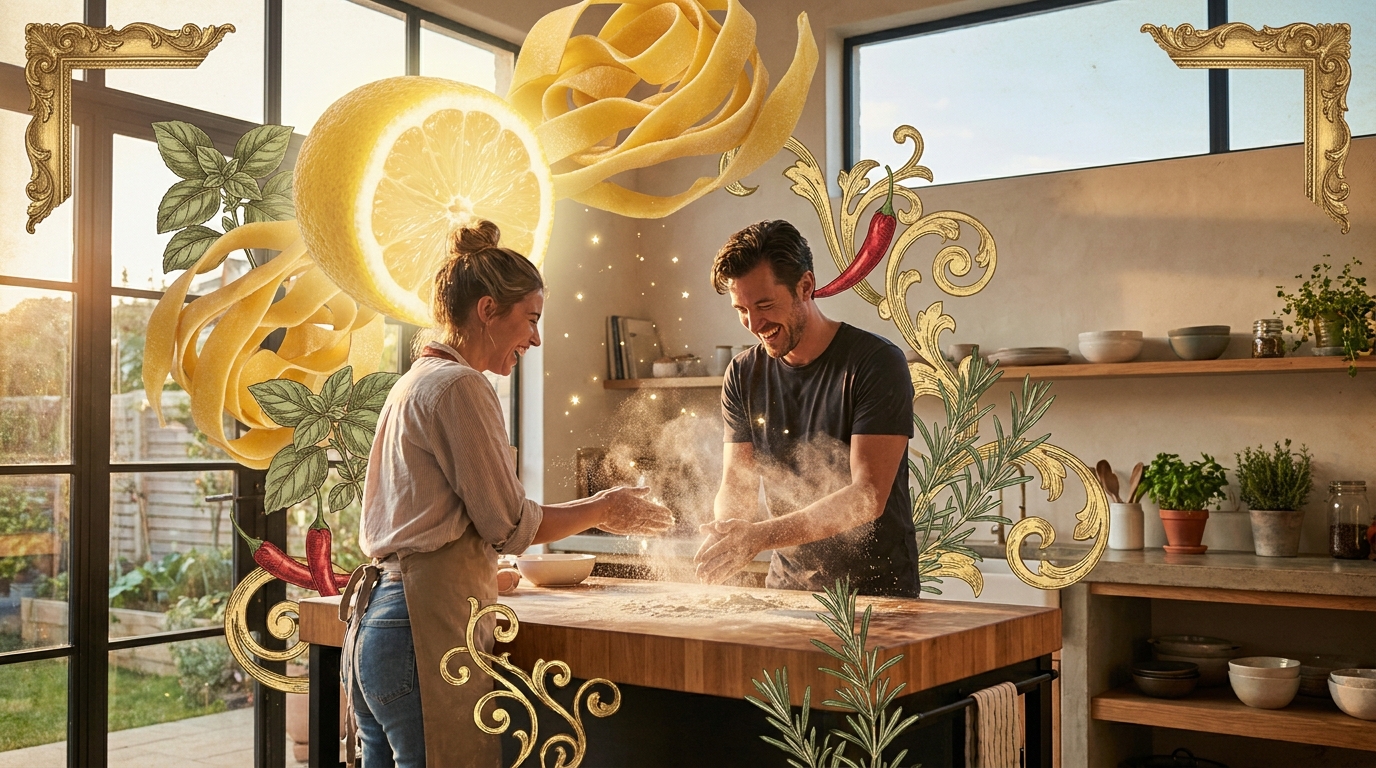
Yes — cooking together improves your relationship, but only when it stops being a task and starts being attention. Chores are two people finishing dinner. Foreplay is two people noticing each other while dinner happens. Same kitchen, same recipe. Completely different night.
TL;DR
- The kitchen is the one room where you're already close, already moving, and already touching — which is why it can flip from chore-land to charged faster than any restaurant can.
- The difference isn't the menu. It's whether you're coordinating (divide, conquer, done) or collaborating (one dish, both pairs of hands, no exit strategy).
- Research on novelty and shared activity keeps landing on the same thing: couples who do slightly challenging things together report more attraction than couples who relax side by side.
- One shift to try tonight: cook one dish neither of you has made, both of you in it, phones in the other room. That's it. That's the whole assignment.
- If you want the evening designed instead of improvised, Appetite for Seduction's Zodiac Date Night Guides build the menu, the pacing, and the arc around how your specific partner experiences desire.
Why Cooking Together Works When Date Night Doesn't
Here's the thing about the standard date night: you put on real pants, drive somewhere, sit across a table — and bring the exact same conversation you'd have had at home. The location changed. The dynamic didn't. Then you split a dessert, drive home, and wonder why it felt like a very expensive Tuesday.
The kitchen doesn't have that problem, because the kitchen doesn't ask you to perform a romantic evening. It gives you something to do. You're standing, moving, passing things, reaching past each other for the salt. There's heat and steam and something that smells incredible at the twenty-minute mark. Your hands are busy, which means your guard is down — and that's when people actually flirt.
Esther Perel — the psychotherapist who reshaped how the world talks about long-term love — has spent a career on the puzzle of sustaining desire in long-term love, and one of her sharpest observations is that desire needs a little novelty, a little pursuit, a little not-quite-certainty. A restaurant hands you a script. A kitchen hands you a situation.
Don't get me wrong — I love a great restaurant. But if the goal is to feel like lovers instead of co-managers, the room with the knives and the open flame is doing more for you than the room with the waiter.
Cooking Together vs. Being in the Kitchen at the Same Time
Now, the fine print — because plenty of couples “cook together” every night and feel absolutely nothing. FR. You know the version I mean. One person chops, one person stirs, someone empties the dishwasher mid-sauce, and the whole thing runs like a well-rehearsed shift at a café where the coworkers don't date.
That's not cooking together. That's coordinating. It's the kitchen as project management: divide the tasks, minimize the friction, get to the eating part. Efficient? Absolutely. Sexy? It is not. Efficiency is what turned you into really good roommates in the first place — the kitchen just makes the pattern visible enough to catch.
Collaboration is a different animal. One dish. Both of you inside it. You have to talk, taste, negotiate — is this enough lemon, do we dare more chili — and you have to stay in the room, because the dish needs both of you. John and Julie Gottman — the married research team who have spent four decades studying what actually makes couples last — call these small deliberate practices rituals of connection — and a shared dish is one of the easiest rituals there is, because dinner was already happening anyway.
This is exactly why I'm building Craft NightBachelorette Parties around making one thing together rather than assembling a menu fast — join the list and you'll know the moment it opens. The structure forces collaboration. The collaboration does the rest.
The Science: What Shared Cooking Actually Does to a Couple
This isn't a vibe — it's one of the most replicated findings in relationship research. Psychologist Arthur Aron — the researcher behind the famous “36 questions that lead to love” study — built his classic work on self-expansion found that couples assigned to novel, slightly challenging shared activities came out reporting more attraction and satisfaction than couples given pleasant, familiar ones. Comfort is lovely. Comfort is also forgettable.
A new dish is novelty in its cheapest, lowest-stakes form. Nobody has to book anything. And work in the Journal of Social and Personal Relationships keeps tying long-term desire to exactly this kind of shared newness rather than shared routine.
Then there's the sensory layer. Food hits smell, taste, touch, temperature — the same channels attraction runs on, which is why researchers who study attraction keep circling back to shared sensory experience. A screen gives you one sense and asks for none of you. A kitchen surrounds you. Your nervous system knows the difference even when your calendar doesn't.
And here's my favorite part, after eight years of watching couples do this: the kitchen removes the pressure of face-to-face intensity. You're shoulder to shoulder, eyes on the task — which is precisely when people say the true thing, the flirty thing, the thing they'd never open with across a table. The dish is the excuse. It just might lead to something...
How to Tell Which Kitchen You're Running
Quick diagnostic. Chores-kitchen: you divide tasks without discussing it, the TV or a podcast is on, one of you leaves the room while something simmers, and the first full sentence you exchange is “can you grab plates.” Foreplay-kitchen: you're making one thing, you keep tasting off the same spoon, somebody gets flour on somebody on purpose, and dinner runs late because nobody's in a hurry.
Most couples run the first kitchen five nights out of five and can't figure out where the spark went. It didn't go anywhere. It's standing next to the stove, waiting for you to change the choreography. Appetite for Seduction's whole Zodiac Seduction Guide collection exists because the choreography is different for different people — what reads as playful to one partner reads as chaos to another, and the difference is knowable.
What to Try Tonight
One assignment. Pick a dish neither of you has ever made — not fancy, just new. Fresh pasta. A curry from scratch. Anything with dough, honestly; dough is doing more for couples than most therapists. Phones in the other room. One cutting board, on purpose. Cook the whole thing four-handed, taste as you go, and eat it facing each other.
That's the free version, and it's real — try it. The designed version, where the menu matches how your partner is actually wired, the pacing is built, and you're never left improvising the mood: that's what the guides are for. Take the Food Fantasy Quiz first if you don't know where to start — it'll tell you more about your person in three minutes than the last three date nights did.
The kitchen's already there. The stove already works. For real — go.
An entire evening built around how your partner actually experiences desire.
Frequently Asked Questions
Does cooking together actually improve your relationship?
Yes — when it's collaborative. Research on shared novel activities consistently links doing slightly challenging things together with higher attraction and satisfaction. The catch: dividing kitchen tasks efficiently doesn't count. One dish, both people, is what moves the needle.
Why is cooking together so romantic?
Because it's the rare activity that's sensory, cooperative, and low-pressure at once. You're close, moving, touching, tasting — with your attention on the dish instead of on performing romance. That side-by-side ease is where real flirtation shows up.
How do we cook together without fighting?
Shrink the stakes. Pick something neither of you has made, so nobody's the expert and nobody's the assistant. AFS founder Shani Delamor's rule from eight years of teaching couples: one dish, four hands, no scoreboard. The goal is the evening, not the plating.
Is cooking together a good date night idea?
It's one of the best, because it fixes the thing restaurant date nights can't: it changes the dynamic instead of the location. Appetite for Seduction's Zodiac Date Night Guides turn it into a full designed evening — menu, pacing, and mood matched to your partner's sign.
What should couples cook together on a date night?
Something new to both of you, with built-in collaboration — fresh pasta, dumplings, anything with dough. Skip dishes that split into solo stations. If you want it chosen for you, the Food Fantasy Quiz points you to the right guide in about three minutes.
How do I get my partner to cook with me?
Don't sell it as connection homework — invite them into something specific. “I'm making pasta from scratch Thursday and I need your hands” lands better than “we should cook together more.” Specific, playful, and slightly novel wins every time.
Sources
- Esther Perel — “Desire in Long-Term Relationships.” estherperel.com
- The Gottman Institute — “Rituals of Connection.” gottman.com
- Psychology Today — Self-Expansion Theory (Arthur Aron). psychologytoday.com
- Journal of Social and Personal Relationships — shared novelty and relationship vitality. journals.sagepub.com