What Actually Happens at a Couples Cooking Class?
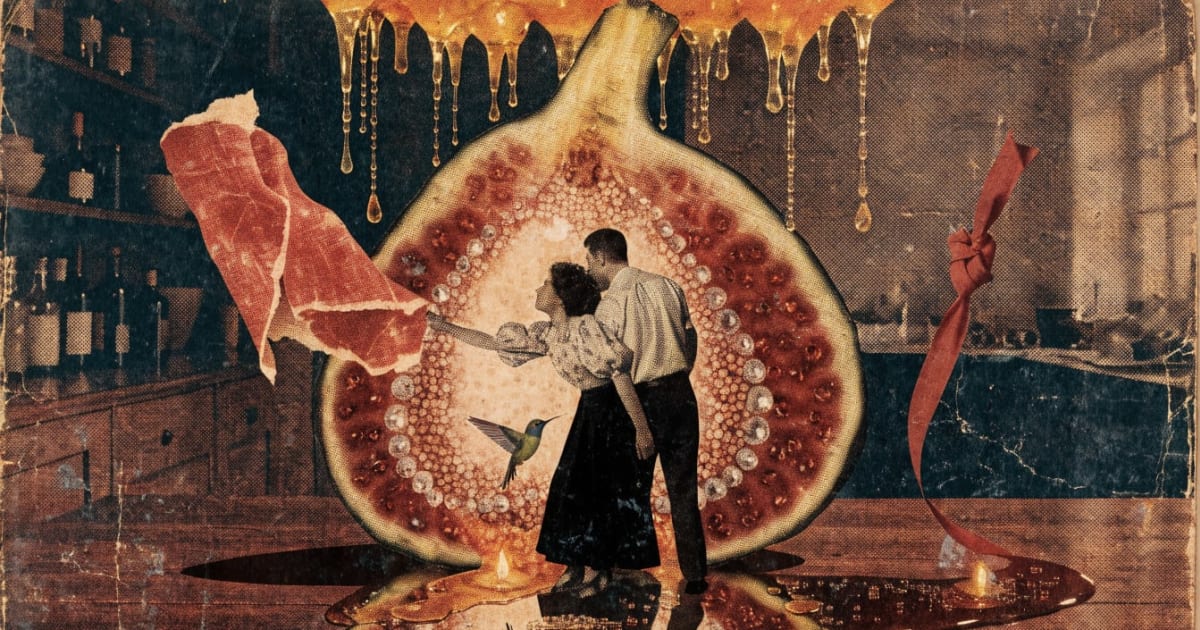
Two hands, one knife, one fig split down the middle on the board between them. Honey pooling in the crease. A torn ribbon of prosciutto laid over top, going translucent in the warmth of the kitchen lights. Neither of them has said much in the last two minutes. Nobody's performing — they don't have to, because their hands are busy, and busy hands don't need to fill silence.
That's the first ten minutes of a couples cooking class, and it is not what most people picture when they picture one. They picture an instructor talking at the front of a room, two people standing awkwardly in aprons, forced small talk over a cutting board. What actually happens is closer to a controlled unwinding — and after eight years of watching it happen, the order turns out to be the entire method.
What's the first thing that actually happens in the room?
Every class starts the same way, and it's never with a lecture. It starts with something small and specific in each person's hands — a fig to split, a shallot to mince, anything sharp enough to demand real attention and small enough not to intimidate anyone in the room. That's not filler before the real class starts. That's the real class, already underway, wearing prep as its disguise.
Facing someone across a table — first date or fifth anniversary, doesn't matter — puts all the pressure on eye contact and conversation, and most people freeze a little under that kind of direct attention. Standing shoulder to shoulder over a cutting board does the opposite: same closeness, none of the stare. You can talk, or not talk, and either way it reads as fine. By the time the fig is split and the honey's out, something in the room has already shifted. Hands first. Everything else later.
Why does she tell aphrodisiac stories while people are still cutting?
Because someone has to go first, and it's never going to be the person worried their knife skills aren't good enough. I tell the aphrodisiac stories on purpose, and I tell them early, while people still have something in their hands to look at instead of me. They're funny, a little "sexy," genuinely historical — the fig alone has been standing in for desire since long before anyone put one on a cheese board, an open fig being what the old food histories politely call an emblem of the feminine. I've already said the riskier thing, so nobody at the board has to. Laughter arrives without anyone being put on the spot for it. And then — only then — I ask how they met.
When does "how did you two meet?" actually land?
Ask it in the first thirty seconds and it's a stranger's question — polite, a little intrusive, answered in whatever shorthand gets you out of actually thinking about it, because you don't know this person yet, whoever's asking. Ask the same six words forty minutes in, once hands have been moving and the room has already laughed together at something ridiculous, and it stops being the same question entirely. People give the long version. The real one, with the parts they usually skip past. Same words. Different permission. Never at the door.
This is what cooking together does for a couple that a dinner reservation can't manage on its own — nobody hands you a knife and a job before asking about your life. It's also most of what separates a class from just feeling like roommates who happen to share a kitchen: the task comes first, the intimacy follows it, never the other way around.
If any of this sounds like a fantasy you didn't know had a name, it does — and figuring out what yours actually looks like takes about three minutes.
By the end of the night, the fig from the opening course is long gone, except for one somebody never got around to on the board. It sits there through the last of the stories, through the laughing, through somebody finally admitting how they really met — and then a hand reaches for it, unhurried, and eats it right in that beat, story still hanging in the air.
Curious what your own food fantasy actually looks like? Take the quiz — it takes about three minutes, and it tells you more than you'd expect.